Friends of Salt Springs Park – Preserving a Piece of Pennsylvania Paradise
by William Murphy
Salt Springs Park Pennsylvania is one of the rare places in the Northeast where genuine old-growth forest, dramatic gorge scenery, and active volunteer stewardship all come together in one spot. The Friends of Salt Springs Park is the nonprofit organization making sure it stays that way — and if you care about protecting natural spaces, understanding their work is worth your time. For more on how outdoor enthusiasts are shaping environmental conservation across the country, you're in the right place.
The park covers roughly 405 acres in Susquehanna County, in the northeastern corner of Pennsylvania. It's not a large park by national standards, but what it contains is extraordinary: a narrow hemlock-lined gorge carved by Fall Brook, a picturesque waterfall, and several miles of trails that range from easy streamside strolls to steeper ridge-top routes. The land has a complicated history, and the story of how it got from logged-over hillside to protected natural reserve is worth knowing.
Citizen-driven conservation organizations like this one exist throughout Pennsylvania and beyond. Groups such as the Westmoreland Conservancy operate on similar principles — dedicated volunteers extending the reach of public land management in ways that government budgets alone can't cover. Each organization has its own approach, but the underlying commitment tends to look the same from one to the next.
Contents
- The History and Origins of Salt Springs Park Pennsylvania
- What to Expect When You Visit Salt Springs Park
- How the Friends of Salt Springs Park Support Long-Term Conservation
- Four Practical Ways to Support the Friends Organization Today
- Addressing Common Questions About Preservation and Access
- Key Takeaways
The History and Origins of Salt Springs Park Pennsylvania
From Logging Country to Protected Land
The land that makes up Salt Springs Park Pennsylvania today was shaped by forces that had nothing to do with preservation. Like most of northeastern Pennsylvania, Susquehanna County was heavily logged throughout the 19th century. Eastern hemlock was especially valuable — its bark was harvested for tannin, a critical ingredient in leather production, and the timber itself was in constant demand. By the late 1800s, the region's forest cover had been dramatically reduced.
What survived at Fall Brook gorge did so largely by accident. The steep gorge walls and unstable footing made commercial logging impractical in the most dramatic sections of the terrain, and so a remnant stand of old-growth hemlock persisted while the surrounding hillsides were stripped. That survival by inaccessibility is one of the park's defining characteristics — a piece of pre-colonial forest that endured not because someone protected it, but because it was too difficult to cut down.
How the Park Came to Be Preserved
The land eventually came under state management and was designated as a Pennsylvania state park, overseen by the Pennsylvania Department of Conservation and Natural Resources. Trail systems were developed over the decades, and the park opened to recreational visitors. The Friends of Salt Springs Park formed later as a citizen support organization — a registered nonprofit that partners with state park managers to provide programming, fundraising, advocacy, and hands-on stewardship that the agency alone couldn't sustain.
This partnership model has become a cornerstone of public land management across the country. You'll find similar structures at the Manada Conservancy in central Pennsylvania, where private citizen groups have taken on meaningful conservation responsibilities alongside public agencies. It's a practical solution to a real problem: state parks are often underfunded, and volunteer organizations can fill gaps that bureaucratic structures simply can't reach.
What to Expect When You Visit Salt Springs Park
The Gorge Trail and Waterfall Experience
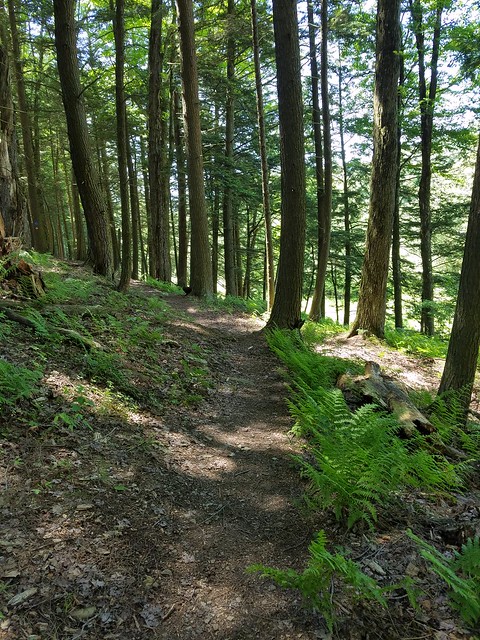
The trail system at Salt Springs Park Pennsylvania centers on the Gorge Trail, which follows Fall Brook through a narrow, moss-covered corridor of hemlock and rock. It's a moderately challenging hike — not technical, but with enough elevation change and uneven terrain to give you a proper workout. The payoff is significant. The trail brings you close to the stream at multiple points, and the combination of cold rushing water, old hemlocks, and steep gorge walls creates an atmosphere that feels genuinely removed from everyday life.
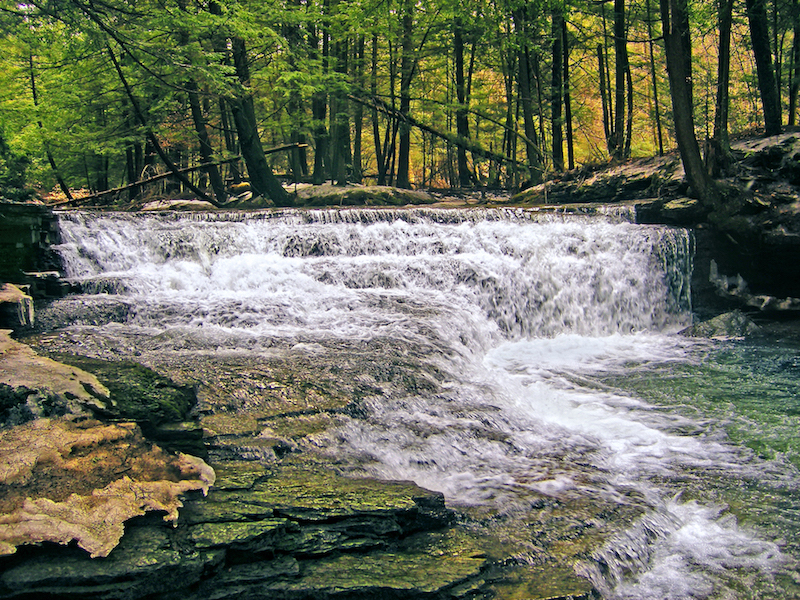
The waterfall at Fall Brook is the park's most photographed feature, and it earns the attention. The drop into the plunge pool below is dramatic in every season — surrounded by ice formations in winter, framed by ferns in summer. If you've explored places like the Laguna Greenbelt and Coastal Greenbelt Preserve, you'll recognize that particular quality of an intact natural corridor — a place where the ecology hasn't been fragmented into isolated patches.
Wildlife and Ecological Value
Beyond the scenery, Salt Springs Park Pennsylvania supports a meaningful range of native species. The cold, clean streams are ideal habitat for brook trout — a species that functions as a reliable ecological indicator. If brook trout are present and thriving, the water quality is high and the surrounding forest is doing its job. The hemlock canopy creates a microclimate that keeps stream temperatures stable, supporting aquatic life that warmer, more disturbed waterways can't sustain.
The old-growth hemlock stands are ecologically significant in a way that's easy to underestimate. True old-growth forest is exceedingly rare in the eastern United States — the vast majority of what you walk through on any given hike has regrown from cleared or logged land within the past century and a half. A surviving stand like this represents a direct biological continuity with the pre-colonial landscape, and that makes it worth protecting with unusual care.
How the Friends of Salt Springs Park Support Long-Term Conservation
The Organization's Core Mission and Structure
The Friends of Salt Springs Park operates as a nonprofit volunteer organization that supplements state park management with additional resources and programming. Their work includes trail maintenance, educational events, fundraising for capital improvements, and advocacy in local planning conversations that affect the park's surrounding landscape. They also serve as a community hub — connecting people to the park in ways that a state agency's outreach capacity rarely can.
Volunteer conservation groups like this one consistently face the same structural challenge: balancing immediate operational needs against longer-term strategic priorities. Clearing a downed tree feels urgent. Planning a multi-year invasive species removal program requires sustained organizational capacity that's much harder to build and maintain. The Friends group has navigated this tension by developing structured programming that addresses both the day-to-day and the long view simultaneously.
Pro tip: When evaluating any volunteer conservation organization, look for ones that publish annual reports or regular project updates — transparency about how funds and labor are allocated is one of the most reliable indicators of organizational health and longevity.
Partnerships and Sustainable Funding
Like most citizen conservation organizations, the Friends group funds its work through a mix of membership dues, individual donations, small grants, and event revenue. Guided hikes, seasonal workshops, and community programs serve double duty — they generate income and build the kind of public awareness that turns casual visitors into committed supporters. That combination is hard to replicate through grants alone.
This diversified funding model is standard practice among successful conservation nonprofits. You see it at the Lancaster County Conservancy in Pennsylvania and at organizations like the Florida Native Plant Society, where events and memberships keep operations running while larger grants fund significant restoration projects. The underlying principle is the same everywhere: no single funding stream should dominate the budget, because any one source can disappear without warning.
| Trail | Difficulty | Approx. Length | Key Feature |
|---|---|---|---|
| Gorge Trail | Moderate | ~2 miles | Fall Brook waterfall, old-growth hemlock |
| Rim Trail | Easy–Moderate | ~1.5 miles | Ridge views, connecting loops |
| Meadow Loop | Easy | ~0.75 miles | Open fields, wildlife observation |
| Lower Brook Path | Easy | ~0.5 miles | Streamside access, family-friendly |
Four Practical Ways to Support the Friends Organization Today
Joining as a Member or Donor
The most straightforward way to support the Friends of Salt Springs Park is through membership. Annual dues go directly toward park programming and maintenance, and most conservation nonprofits structure tiered membership levels to accommodate different giving capacities. You don't need to live in Susquehanna County — or even in Pennsylvania — to join. Remote members and online donors are a meaningful part of most friends-group revenue pictures, and the contribution is just as useful regardless of where you're located.
Volunteering on the Ground
Membership provides financial support. Showing up provides labor, which is often just as valuable. The Friends group organizes regular volunteer days focused on trail clearing, invasive species removal, and facility upkeep. These events are open to individuals and families, and no prior experience is required — organizers supply tools, safety orientation, and direction. You put in a few hours, and the result is directly visible by the end of the day.
There's a satisfying connection between responsible outdoor stewardship at home and volunteering at a place like Salt Springs Park. The same mindset that leads you to manage leaves and yard debris thoughtfully — working with the land rather than against it — translates naturally into trail maintenance and habitat restoration. The scale is different, but the underlying attentiveness is the same.
Addressing Common Questions About Preservation and Access
Can More Visitors Actually Help Conservation?
This is a question conservation organizations wrestle with constantly. More visitors means more foot traffic, more potential for trail erosion, and more risk of people wandering off marked paths into sensitive habitat. The short answer is that overuse can cause real damage. But the longer answer is more nuanced, and it tends to favor opening parks up rather than closing them off.
Informed visitors are an asset to conservation, not a liability. People who understand what a trail protects and why it exists tend to behave very differently from people who treat the outdoors as a generic recreational backdrop. Education is the primary mechanism conservation groups use to convert casual visitors into active stewards. Interpretive signage, guided hikes, and community programming all serve this function — and the Friends of Salt Springs Park invests in all three.
What Responsible Visiting Looks Like in Practice
You don't need to volunteer or donate to do conservation work at Salt Springs Park Pennsylvania. Staying on marked trails, packing out everything you bring in, avoiding wildlife disturbance, and leaving plants undisturbed are all active contributions to the park's long-term health. These aren't rules designed to limit your experience — they're the practical behaviors that allow the experience to keep existing for everyone who comes after you.
Research from organizations working in comparable environments consistently shows that education and access, done well, support ecological health rather than undermine it. Florida Defenders of the Environment has been navigating the tension between public access and habitat protection since the late 1960s, and the evidence they've gathered points in the same direction: engaged visitors who understand what they're looking at become the park's most reliable advocates. That's a finding worth holding onto the next time you lace up your hiking boots.
Key Takeaways
- Salt Springs Park Pennsylvania contains one of the eastern United States' rare surviving old-growth hemlock stands, making it ecologically significant well beyond its modest acreage.
- The Friends of Salt Springs Park is a volunteer nonprofit that partners with Pennsylvania state park managers to fill programming, maintenance, and advocacy gaps that public funding alone can't cover.
- You can support the organization through membership, direct donation, or hands-on volunteering — and you don't need to live nearby to make a meaningful contribution.
- Responsible visitor behavior — staying on trails, packing out trash, leaving plants undisturbed — is itself a form of active conservation that costs nothing and compounds over time.


About William Murphy
William Murphy has worked as a licensed general contractor in Fremont, California for over thirty years, specializing in outdoor structures, green building methods, and sustainable design. During that career he has written about architecture, construction practices, and environmental protection for regional publications and trade outlets, bringing technical depth to subjects that most home improvement writers approach only from a consumer perspective. At TheBackyardGnome, he covers outdoor product reviews, backyard construction guides, and sustainable landscaping and building practices.
You can Get FREE Gifts. Receive Free Backyard Items here. Disable Ad Blocker to get them all now!
Once done, hit anything below