What separates a forgettable backyard from one that makes guests stop mid-sentence and actually look down? Our team has studied hundreds of outdoor living spaces over the years, and the answer keeps pointing back to one material. Slate patio design ideas consistently deliver that combination of natural texture, deep color variation, and structural longevity that poured concrete simply cannot replicate. This guide — part of our complete patio design resource — covers nine inspiring approaches, the real costs involved, and the mistakes worth avoiding before the first slab ever goes down.
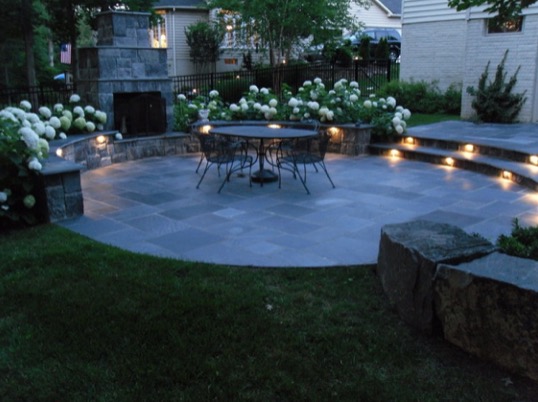
Slate is a fine-grained metamorphic rock that cleaves naturally into flat, layered sheets — a property called foliation. That structural tendency is exactly what makes it such a practical paving material. According to Wikipedia's overview of slate geology, the rock forms under low-grade metamorphic conditions from shale or mudstone, which explains the characteristic earthy palette: charcoal grey, forest green, burnt rust, and deep purple. Those tones age with elegance rather than fading into monotony.
Our team consistently recommends slate when homeowners want a natural stone patio that feels distinctive without crossing into full-luxury budget territory. Anyone comparing options should read our breakdown of flagstone patio ideas, costs, and installation tips — slate shares many installation principles with flagstone but brings its own set of quirks worth understanding upfront. It also occupies a distinct aesthetic lane compared to the cool blue-grey tones of bluestone, which dominates many traditional Northeast patios.
Contents
- When Slate Is the Right Choice (and When It Isn't)
- Nine Slate Patio Design Ideas That Actually Inspire
- Mistakes That Ruin an Otherwise Great Slate Patio
- How to Plan and Install a Slate Patio
- Quick Upgrades That Transform Any Slate Patio
- Common Slate Myths Our Team Keeps Hearing
- Understanding Slate Patio Costs Before Breaking Ground
- Frequently Asked Questions
- Final Thoughts
When Slate Is the Right Choice (and When It Isn't)
Not every backyard is a strong candidate for slate. Our team has seen both beautiful long-lived installations and expensive short-lived disasters — and the difference almost always comes down to matching the material to the conditions before any money changes hands.
The Situations Where Slate Excels
Slate performs exceptionally well under specific conditions:
- Covered or semi-covered patios — reduced freeze-thaw cycles extend slab life dramatically
- Moderate climates with mild winters and relatively dry summers
- Spaces where aesthetic character matters more than strict uniformity
- Patios adjacent to gardens and planting beds, where slate's earthy tones complement greenery naturally
- Smaller patio footprints where material costs stay manageable
- Projects that incorporate a fire feature — our roundup of sunken fire pit ideas shows how effectively natural stone frames these outdoor focal points
When Another Material Makes More Sense
There are situations where our team steers people away from slate entirely:
- Harsh freeze-thaw climates without a deep compacted base — slate can delaminate and crack when moisture penetrates and expands repeatedly through the stone
- Pool surrounds — the porous surface stays wet longer, increasing both slip risk and biological growth
- High-traffic commercial settings — slate does not tolerate heavy rolling loads over time
- Steeply sloped patios without a strong drainage plan — standing water degrades the stone faster than any other single factor
- Projects with an installed budget under $8 per square foot — cutting corners on slate installation always produces regrettable results within a few seasons
Nine Slate Patio Design Ideas That Actually Inspire
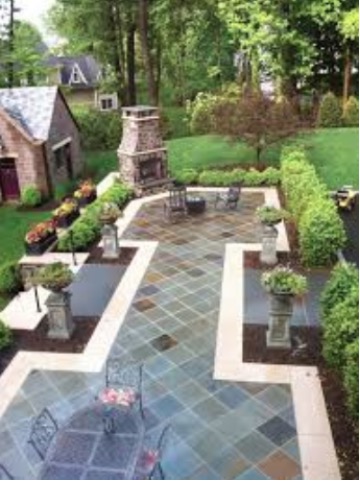
Our team has pulled together the best slate patio design ideas from real installations — not CGI renders or showroom mock-ups. These nine approaches cover a range of budgets, climates, and visual styles.
Classic Irregular Flagstone
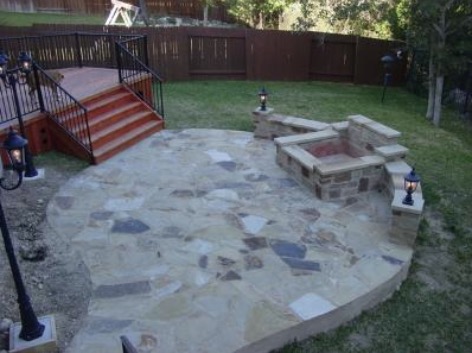
Irregular flagstone is the most forgiving slate layout for DIY installation. The organic, puzzle-like arrangement hides minor cutting imprecision naturally, creates a relaxed cottage-garden aesthetic, and works especially well with low-growing ground cover plants tucked into the joints. Creeping thyme and sedum are both excellent choices — they fill gaps within a single growing season and add fragrance when walked on.
Warm-Tone and Rust Arrangements
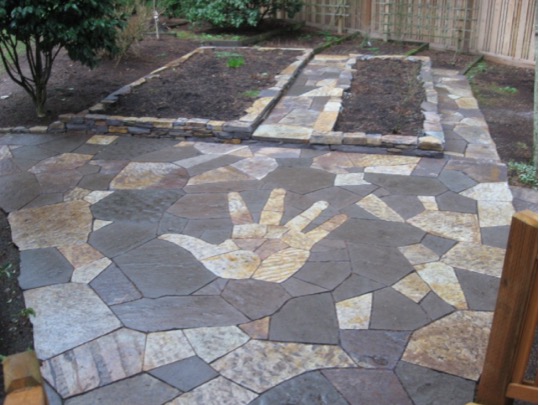
Rust and amber slate creates an inviting warmth that grey concrete patios can never achieve. Warm-toned slate pairs exceptionally well with cedar and redwood furniture — the complementary earth tones unify the entire outdoor space visually rather than pulling it in competing directions. Anyone choosing furniture for this type of patio should review our guide to naturally bug and rot resistant wood types for patio furniture before committing to a material.
Vijaya Gold With Raised Planters
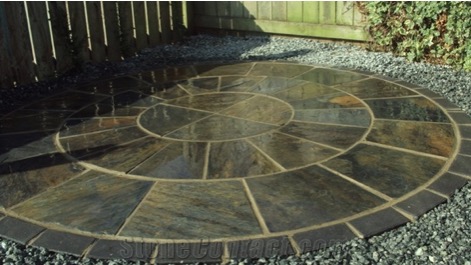
Vijaya Gold is a warm golden-toned slate quarried in India that brings genuine warmth to any outdoor space. Paired with raised timber sleeper flower beds, it creates a layered garden patio that feels deliberately designed rather than assembled piece by piece. The contrast between the gold stone surface and dark timber edges is visually strong without being loud — a combination our team returns to repeatedly in project recommendations.
Slate-Wood Hybrid Decks
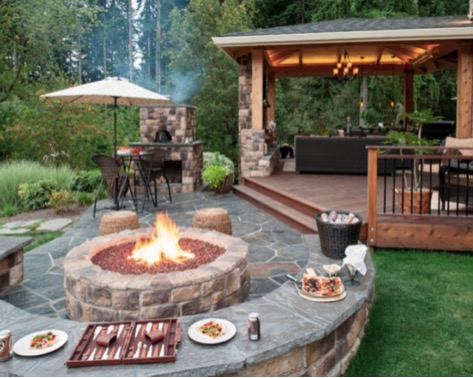
Combining slate with timber decking zones creates one of the most versatile outdoor layouts possible. The material transition between hard stone and warm wood defines separate functional areas without fences or walls. In our experience, the slate section handles the dining and grilling zone well, while the wood deck naturally becomes the lounging area — the perfect spot for zero gravity seating after a long day.
Mediterranean-Inspired Layouts
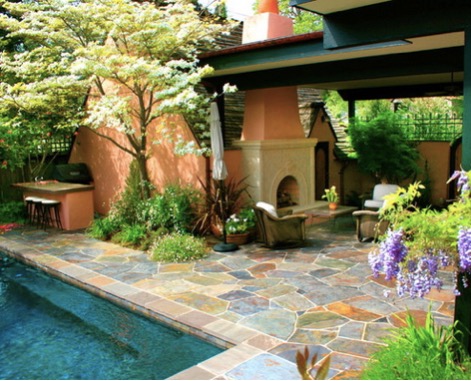
Mediterranean slate patios lean into warm terracotta tones, irregular shapes, and lush planting borders. This style works best with a narrow joint filled with sand or fine gravel, which allows plants to colonize the gaps over time — producing that lived-in European courtyard feeling that uniform pavers simply cannot replicate.
Beyond these five core layouts, our team also recommends exploring four additional approaches:
- Peach-tone flagstone blends — warm peachy slabs mixed with grey tones create subtle color depth without reading as busy or overdone
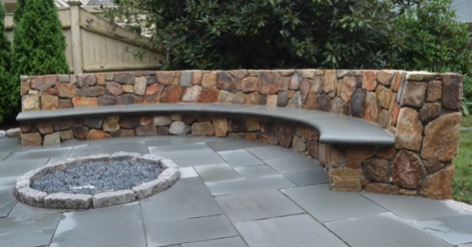
- Fieldstone border framing — using larger, rougher fieldstone as a perimeter sets the slate surface apart visually and adds structural mass to the edges
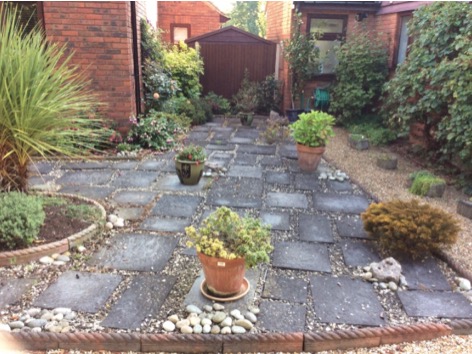
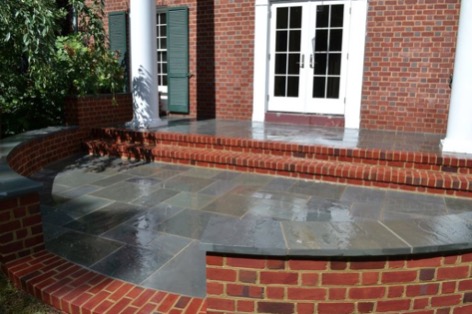
- Red brick and slate combinations — traditional brick borders around a central slate field give the design a formal, structured feel that suits traditional home architecture well
- Overlay remodels — thin slate tiles laid directly over an existing concrete patio are an underrated renovation option, particularly for homeowners on a tighter budget
Mistakes That Ruin an Otherwise Great Slate Patio
Our team has diagnosed dozens of failed slate installations over the years. The same errors come up repeatedly. Avoiding them is not complicated — but most people don't know what to look for until the damage is already done.
Installation Errors
- Skipping the compacted gravel base — a 4–6 inch compacted crushed stone layer is non-negotiable; without it, slabs shift and crack within two seasons
- Laying slabs on sand-only beds over clay-heavy soils — clay retains water and causes frost heaving that systematically dislodges every slab
- Inconsistent joint width — wildly varying joints look careless rather than organic
- Using standard Portland cement mortar — slate requires a flexible, polymer-modified mix to accommodate minor thermal movement
- Ignoring drainage slope — the patio surface needs a minimum 1/8-inch drop per linear foot, directed away from the house foundation at every point
Pro insight from our team: Never seal slate immediately after installation. Our team waits a minimum of 30 days for mortar to fully cure before applying any penetrating sealer — sealing too early traps moisture and causes premature delamination of the stone surface.
Material Selection Errors
- Purchasing mixed-thickness slabs without a leveling strategy — slabs ranging from 3/4 inch to 1.5 inches create surface height variation that becomes a tripping hazard
- Choosing interior-rated slate tile for outdoor applications — some calibrated slate products are designed for interior floors and lack the surface texture required for safe outdoor use
- Applying a topical sealer instead of a penetrating one — topical sealers trap subsurface moisture and cause spalling; penetrating sealers are the only appropriate choice for exterior slate
How to Plan and Install a Slate Patio
Our team recommends a three-phase approach for any slate patio project. Each phase has specific tasks that must be completed before the next phase begins — shortcuts in any one phase compound into serious problems later.
Phase 1 — Planning and Layout
- Measure the space and sketch dimensions on paper with the house footprint included for reference
- Determine drainage direction — water must run away from the foundation at every point on the patio surface
- Choose a slate type (irregular flagstone, regular cut, or mixed) and calculate total square footage plus a 10% waste buffer
- Decide on joint style — tight-set (1/4-inch joints) or open-set (1–2 inch joints for ground cover planting)
- Call 811 (in the US) to have underground utilities marked before any excavation begins
Phase 2 — Ground Preparation
- Excavate 6–8 inches below the finished surface grade to accommodate base layers
- Lay a geotextile landscape fabric to suppress weed growth without blocking drainage
- Add 4–6 inches of compacted angular crushed gravel — 3/4-inch angular stone, not rounded pea gravel
- Add a 1-inch sand setting bed on top of the compacted gravel layer
- Verify slope throughout with a long level — confirm the 1/8-inch minimum drop per linear foot is consistent
Phase 3 — Setting the Slabs
- Dry-lay the entire slate arrangement before mixing any mortar — this is the single most important step in the entire process
- Mix polymer-modified mortar to a peanut butter consistency — too wet and it won't hold; too dry and adhesion fails
- Back-butter each slab and press firmly into place using a rubber mallet
- Check each slab with a level immediately after setting, adjusting while the mortar is still workable
- Allow the setting bed to cure 24–48 hours before grouting the joints
- Apply penetrating sealer 30 days after full installation is complete — not before
Quick Upgrades That Transform Any Slate Patio
Not every improvement requires a full reinstall. Our team has a short list of high-impact, low-effort upgrades that make an immediate difference on existing slate patios.
Immediate Visual Improvements
- Power wash and re-seal — a single afternoon of work that can make a dull, algae-stained patio look completely renewed
- Re-pointing deteriorating mortar joints with matching polymer grout — joint deterioration is the primary source of progressive slab instability
- Adding low-voltage landscape lighting along patio edges — uplighting a slate surface at night transforms the entire yard's atmosphere with minimal installation effort
- Planting low-growing thyme or sedum into open gravel joints — the contrast of stone and living plants is the defining visual of the best natural slate patios
Low-Effort Maintenance Wins
- pH-neutral stone cleaner is the correct choice for routine care — our team avoids vinegar and bleach entirely, as both etch and discolor slate surfaces over repeated use
- Penetrating sealer re-application every 2–3 years is our standard maintenance schedule for temperate climates, with annual applications recommended in harsh freeze-thaw regions
- Prompt autumn leaf clearing matters more than most people realize — tannin staining from decomposing leaves penetrates unsealed slate and is extremely difficult to reverse once set
Common Slate Myths Our Team Keeps Hearing
Misinformation about slate circulates widely in home improvement circles. Our team keeps encountering the same five misconceptions — here is what the evidence actually supports.
- Myth: Slate is too slippery for outdoor use.
Natural cleft slate has excellent texture and traction. Polished interior slate is a completely different product — exterior-rated natural slate is specifically selected for its rough, non-slip cleft surface. - Myth: Slate demands constant high-maintenance upkeep.
A properly installed and sealed slate patio needs nothing more than an annual cleaning and sealer reapplication every two to three years. That is significantly less demanding than wood decking by any measure. - Myth: All slate is essentially the same product.
Slate quality varies enormously by quarry origin. Brazilian, Welsh, Chinese, and Indian slate each carry distinct hardness ratings, color stability, and thickness consistency. Our team strongly recommends buying only from suppliers who disclose origin clearly. - Myth: Slate cracks easily under normal use.
Slate is brittle when unsupported — but a properly prepared compacted base eliminates the void-loading conditions that cause cracking. On a solid foundation, slate is an exceptionally durable paving material. - Myth: Slate patios cannot survive cold climates.
Installation quality determines frost resistance, not the material itself. Properly installed with a deep compacted base, adequate drainage, and a good penetrating sealer, slate survives freeze-thaw cycles reliably for decades.
Understanding Slate Patio Costs Before Breaking Ground
Budget planning for a slate patio requires separating material costs from labor costs — and accepting that cutting corners on either consistently produces a patio that underperforms its full potential over time.
Material Costs by Slate Type
| Slate Type | Cost per Sq Ft (Material Only) | Key Characteristics |
|---|---|---|
| Chinese Slate (irregular) | $2–$4 | Lower hardness rating; moderate color variation; wide availability |
| Indian Slate (Vijaya Gold, Multicolor) | $3–$6 | Strong color range; good frost resistance when sealed; widely stocked |
| Brazilian Slate | $4–$7 | Dense composition; excellent freeze-thaw performance; consistent thickness |
| Welsh / UK Slate | $8–$14 | Premium quality; exceptional long-term durability; limited North American supply |
| Base materials (gravel, sand, mortar) | $2–$4 | Per square foot of finished patio area; non-negotiable regardless of slate grade |
Labor and Total Project Budget
Professional installation typically adds $10–$20 per square foot on top of materials, depending on region, complexity, and local labor rates. A straightforward 200 sq ft patio in most US markets works out to:
- DIY total: $1,200–$2,400 in materials only, assuming moderate slate grade
- Professionally installed: $3,400–$6,800 all-in for a standard flat layout
- Curves, multiple levels, or decorative borders add 20–35% to any baseline estimate
Our team considers a well-installed slate patio one of the stronger outdoor investments available. Lifespan runs 30–50 years with proper care versus 10–15 years for the average stamped concrete pad. The per-year cost math strongly favors slate in every calculation we have run.
Frequently Asked Questions
How long does a slate patio last?
A properly installed and sealed slate patio typically lasts 30–50 years, and in some cases considerably longer. The critical variables are base preparation quality, sealer maintenance every 2–3 years, and adequate surface drainage. Welsh and Brazilian slate consistently outperform Chinese slate over long time horizons based on hardness ratings and density.
Is slate patio installation a realistic DIY project?
For irregular flagstone patterns on a smaller patio — yes, with moderate skill and patience. The ground preparation phase is the most labor-intensive part and cannot be shortened without consequences. Cut-stone patterns requiring precise, consistent joints are better handled by professionals, as alignment errors compound quickly and are expensive to correct after the mortar sets.
What is the best way to clean a slate patio?
Our team recommends a pH-neutral stone cleaner applied with a stiff nylon brush, followed by a thorough rinse with clean water. Power washing at 1,200–1,500 PSI works well for general cleaning and biological growth removal. Vinegar, bleach, and general-purpose household cleaners should be avoided — all three etch or permanently discolor slate over repeated applications.
Does slate need to be sealed for outdoor use?
Yes, and our team considers this non-negotiable. A penetrating (impregnating) sealer repels moisture without altering the stone's natural texture or appearance. The first application goes on 30 days after installation — never earlier. Re-application every 2–3 years in temperate climates, or annually in regions with severe freeze-thaw cycles, keeps the stone protected long-term.
How does slate compare to other natural stone patio materials?
Slate is generally softer and more affordable than granite, comparable in price range to sandstone, and less formal in appearance than cut limestone. It carries more color variation and character than most bluestone applications. Anyone exploring alternatives in depth should read both this overview and our detailed flagstone patio comparison guide before making a final material decision.
Final Thoughts
Slate remains our team's top recommendation for homeowners who want a natural stone patio that delivers genuine character without requiring a luxury renovation budget. The slate patio design ideas covered here — from Vijaya Gold with raised timber planters to rust-toned irregular flagstone with planted joints — cover nearly every backyard context and aesthetic. The next step is concrete: pick the layout that fits the space, collect at least three material quotes from local stone yards, and treat base preparation as the single item that cannot be value-engineered out of the budget. A strong foundation is what separates a 10-year patio from a 50-year one, and that difference is worth every dollar spent getting it right.


About William Murphy
William Murphy has worked as a licensed general contractor in Fremont, California for over thirty years, specializing in outdoor structures, green building methods, and sustainable design. During that career he has written about architecture, construction practices, and environmental protection for regional publications and trade outlets, bringing technical depth to subjects that most home improvement writers approach only from a consumer perspective. At TheBackyardGnome, he covers outdoor product reviews, backyard construction guides, and sustainable landscaping and building practices.
You can Get FREE Gifts. Receive Free Backyard Items here. Disable Ad Blocker to get them all now!
Once done, hit anything below