You found a beautiful spot in the backyard, dug the pond, added fish and plants — and now every morning you're out there scooping leaves and scum off the surface with a net. Sound familiar? A good pond skimmer takes that daily chore off your plate by continuously pulling floating debris out of the water before it sinks and starts decomposing. The difference between a clean, healthy pond and a green, smelly mess often comes down to one piece of equipment.
Pond skimmers work by drawing water across a weir (a low dam that lets surface water flow over it) and trapping leaves, pollen, and other floating debris in a basket or net. Most models also house your submersible pump, keeping it protected and easier to access. Whether you have a small decorative water feature or a large koi pond, there's a skimmer sized for your setup. In this 2026 guide, we've rounded up seven of the best pond skimmers on Amazon — from floating units to heavy-duty in-ground boxes — so you can find the right match without the guesswork.
Before you dive in, it's worth thinking about your pond's size, how many fish you keep, and how much maintenance you're willing to do. If you're still planning your water feature, check out our guide on the best location for a garden pond — getting placement right makes cleaning a lot easier down the road. And if you already have a pond and want to explore all the gear that keeps it running, browse our full pond equipment reviews for more recommendations.
Contents
Best Choices for 2026
- #PreviewProductRating
- Bestseller No. 1
 Rating:

- Bestseller No. 2
 Rating:
 - Bestseller No. 3
 Rating:
 - Bestseller No. 4
 Rating:
 - Bestseller No. 5
 Rating:
 - Bestseller No. 6
 Rating:
 - Bestseller No. 7
 Rating:
Full Product Breakdowns

1. Aquascape Signature Series 1000 Pond Skimmer — Best for Large Ponds
If you're managing a large pond — we're talking up to 1,000 square feet of surface area — the Aquascape Signature Series 1000 is built for that kind of workload. This is a box-style in-ground skimmer that mounts flush with your pond's edge, pulling debris over an adjustable weir and into a large rigid basket before it has a chance to sink. The adjustable weir is a feature worth calling out: it lets you fine-tune the water flow rate so the skimmer works efficiently even as your pump output changes with the seasons.
Construction is solid throughout. The body is made from UV-protected, high-density polyethylene (HDPE), which means it won't crack or fade sitting in direct sun year after year. The hardware is corrosion-resistant, so you're not going to find rust problems down the road. The included filter mat adds a second layer of filtration, catching finer particles that get past the debris basket. Cleaning is straightforward — the locking weir door lets you drain water from the skimmer body before you pull the basket, which keeps the mess contained. The faux rock lid blends naturally into a landscaped pond edge, hiding the unit without making it hard to access.
For large koi ponds or water gardens with heavy leaf fall, this skimmer earns its price. It's not the cheapest option on the list, but it's designed to handle serious debris loads without constant emptying. If your pond is on the smaller side, it's more skimmer than you need — but for anything approaching that 1,000-square-foot mark, it's one of the most capable units you'll find.
Pros:
- Handles ponds up to 1,000 sq. ft. — genuinely built for large water features
- Large rigid basket and filter mat combo for thorough mechanical filtration
- UV-protected HDPE body with corrosion-resistant hardware for long-term durability
- Adjustable weir lets you dial in flow rate to match your pump
- Faux rock lid blends into the landscape
Cons:
- Overkill for smaller ponds — sized and priced for large setups
- Installation requires cutting and fitting the liner carefully at the pond's edge
2. Atlantic Water Gardens PS3900 Pond Skimmer — Best for Versatility
The Atlantic Water Gardens PS3900 stands out from the crowd for one practical reason: it can accept two pumps simultaneously. That matters more than it sounds. Running two smaller pumps instead of one large one gives you redundancy (if one pump fails, the other keeps water moving), lets you lower operating costs by running only one pump during lower-flow periods, and opens up multiple spillway options if you're feeding a waterfall or stream. It's a smart design choice that most budget skimmers skip entirely.
Atlantic has built their skimmer line around strength and filtration variety, and the PS3900 reflects that. The 6-inch weir width gives it a solid intake, and the unit is constructed with durability in mind — this isn't a flimsy plastic box that flexes when you pack it with wet leaves. It also houses and protects your pump plumbing inside the body, which keeps everything organized and out of sight beneath your pond's edge.
Where Atlantic really differentiates itself is in the breadth of its skimmer lineup. If the PS3900 isn't the exact size you need, there are larger and smaller models in the same family that all work on the same logic. For a mid-to-large pond where you want flexibility in how you configure your pump setup, the PS3900 offers options that single-pump skimmers simply don't. It's a particularly good fit if you plan to expand your water feature or add additional water elements later.
Pros:
- Dual-pump capability adds redundancy and lowers operating costs
- Part of a complete skimmer family with multiple size options
- Houses and protects pump and plumbing neatly inside the unit
- Strong, durable construction that holds up over seasons
Cons:
- Pumps are sold separately — budget accordingly
- 6" weir width may be limiting for very high-debris ponds
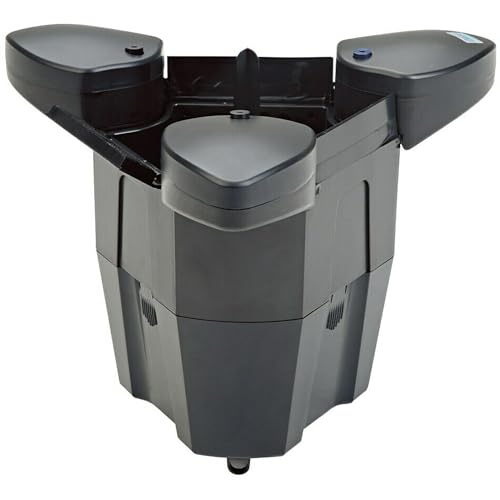
3. Oase Swimskim Pond Skimmer — Best Fixed Unit for Smaller Ponds
OASE is a German brand with a long track record in water garden equipment, and the Swimskim reflects that European precision-engineering approach. This is a fixed-position skimmer (as opposed to the floating version covered next), meaning it mounts in a set location and draws debris toward it through water movement. If your pond has a pump pushing water in a consistent direction, the fixed Swimskim can be positioned to capture that surface flow efficiently.
The unit is compact and relatively unobtrusive, making it a good fit for smaller decorative ponds where you don't want a large box-style skimmer dominating the pond edge. OASE's build quality is consistently above average — the materials feel solid, and the internal components are designed to be cleaned without a lot of fuss. The basket pulls out cleanly and empties easily, which matters more than people realize when you're doing this weekly through fall.
The main limitation of the fixed Swimskim is that it doesn't adapt to changing water levels the way a floating skimmer does. If your pond water level drops during dry summer months, the intake position shifts relative to the surface, and skimming efficiency drops with it. For ponds with stable water levels or those on automatic top-off systems, it works very well. For ponds that fluctuate seasonally, the floating version might be a better call.
Pros:
- Compact design suits small-to-medium decorative ponds
- OASE build quality is consistently reliable
- Easy basket removal and cleaning
- Works well in ponds with stable, consistent water flow
Cons:
- Fixed position means it doesn't adapt to fluctuating water levels
- Less suitable for large, high-volume ponds
4. OASE SwimSkim Floating Pond Skimmer — Best Floating Skimmer
The floating version of OASE's SwimSkim solves the water-level problem elegantly. Because the unit floats directly on the pond surface, it automatically adjusts its intake position as the water level rises or falls — you get consistent skimming performance regardless of season or rainfall. It's designed for ponds up to 270 square feet, and it requires a minimum water depth of 16 inches to operate properly. That puts it squarely in the small decorative pond category, but for that use case, it's hard to beat.
Installation is as close to plug-and-play as pond equipment gets. You drop it in, connect it to a pump, and it floats. There's no liner cutting, no concrete work, no fitting it flush with the pond bank. If you're adding a skimmer to an existing pond and want to avoid disrupting your established setup, the floating SwimSkim is the least invasive option on this list. It integrates cleanly with most existing pond configurations.
The leaf basket is easy to remove and empty — pull it up, dump it out, drop it back in. For a small garden pond, this kind of simple maintenance cycle is exactly what you want. The compact size also means it doesn't visually dominate a smaller water feature. One thing to keep in mind: floating skimmers work best in ponds where surface water actually moves past them. In very still ponds with no circulation, debris may not reach the intake consistently. Pair it with a pump that creates some gentle water movement and it performs much better.
Pros:
- Automatically adjusts to any water level — no reconfiguration needed
- Easiest installation of any skimmer on this list — just float and connect
- Compact and unobtrusive in smaller decorative ponds
- Simple basket removal for fast, clean maintenance
Cons:
- Limited to ponds up to 270 sq. ft. — not for larger water features
- Requires at least 16 inches of water depth to operate
- Works best with some water circulation to move debris toward the intake
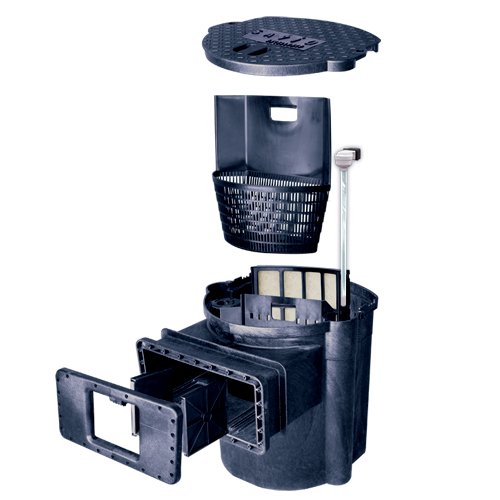
5. Savio Skimmerfilter Pond Skimmer with 16" Faceplate — Best Mid-Size Box Skimmer
The Savio Skimmerfilter with its 16-inch faceplate occupies the mid-range sweet spot — larger than a compact floating unit, but not as massive as the high-capacity Aquascape. The wide faceplate (the front panel through which water enters the skimmer) gives it a broad intake area, which means more water surface coverage per unit of pump flow. That translates to more efficient debris capture without needing to run your pump at maximum output all the time.
Savio has a solid reputation among pond builders, and the Skimmerfilter line is one of their most established products. The box construction is sturdy, and the filtration media included does a good job of mechanically cleaning the water before it reaches your pump. The 16-inch faceplate is particularly effective in rectangular or regularly shaped ponds where you can position the skimmer directly in the path of prevailing water flow.
The one thing to note upfront: the pump is not included. That's standard for box-style skimmers, but if you're outfitting a new pond from scratch, factor that into your budget. On the upside, you get to choose a pump sized exactly to your pond's needs rather than being locked into whatever capacity a bundled pump offers. If you're upgrading an existing setup and already have a compatible pump, the Savio slots in cleanly. It's a well-regarded workhorse skimmer that holds its own in the mid-size pond category.
Pros:
- Wide 16" faceplate delivers broad surface coverage
- Reputable brand with a proven track record in pond equipment
- Good mechanical filtration for mid-sized ponds
- Lets you choose your own pump for precise flow matching
Cons:
- Pump not included — additional purchase required
- Installation requires liner work at the pond edge
6. Blue Thumb Serenity Skimmer Box with Natural Lid — Best Natural Aesthetic
For pond owners who care as much about how their setup looks as how it functions, the Blue Thumb Serenity Skimmer Box deserves a long look. The natural lid is designed to blend into a landscaped pond edge — it looks like a rock or organic feature rather than a plastic utility box. In carefully designed water gardens where aesthetics are a priority, that kind of visual integration matters. You put in the work on your pond's landscaping; the equipment shouldn't undermine it.
Performance specs are practical for a mid-size residential pond: the unit handles up to 1,800 gallons per hour (GPH) of flow and measures 16.25 x 13.25 x 14.75 inches. It removes debris before it settles to the bottom and starts breaking down into sludge — that's the core job of any skimmer, and the Serenity handles it reliably within its flow range. The debris-catching mechanism works on the standard weir principle, pulling floating material into the box where it's trapped and held until you clean it out.
At 1,800 GPH maximum flow, this skimmer is suited to small-to-medium ponds. If you're running a high-powered pump for a large koi pond, you'll want to look at higher-capacity options. But for a decorative water garden with a moderate pump — especially one where neighbors and guests will see the pond edge — the Serenity earns its name. It does the job quietly and without drawing attention to itself. If you want ideas for what to do with the pond surround, check out our small backyard pond ideas for inspiration on creating a complete water garden space.
Pros:
- Natural lid blends into landscaped pond surrounds — one of the best-looking skimmer lids available
- Removes debris before it sinks and creates sludge buildup
- Compact footprint at 16.25" x 13.25" x 14.75"
- Solid 1,800 GPH flow capacity for small-to-medium ponds
Cons:
- 1,800 GPH max limits it to smaller pond setups
- Pump not included
7. EasyPro PS10E ECO-Series Pond Skimmer — Best In-Pond No-Leak Design
The EasyPro PS10E takes a fundamentally different approach than every other skimmer on this list. Instead of mounting outside the pond and cutting through your liner, this unit installs inside the pond liner itself — hence the "in-pond" design in the product name. There's no cutting the liner, no silicone sealing, no penetrations to worry about. The skimmer sits inside the liner, and backfill dirt around the outside holds it firmly in place. If liner leaks around traditional skimmer penetrations have ever cost you sleep, this design eliminates that concern entirely.
The flow capacity is impressive for the price point. The 9-inch water inlet handles up to 8,100 GPH (135 GPM), which puts it in the high-performance tier. That's more than enough for large residential ponds and even light commercial applications. It comes complete with a molded debris basket, filter pad, and lid — everything you need is in the box. The strong-ribbed body construction holds its shape under backfill pressure and resists deformation over time, which is critical for an in-pond installation where you can't easily access the unit to reshape it.
The trade-off with an in-pond design is that accessing the skimmer for cleaning requires reaching into the pond. Depending on your pond's layout and depth, that may or may not be a hassle. The lid sits at the pond edge, which helps, but if you're used to simply lifting a lid on a bank-side skimmer, the EasyPro's setup feels a little different in practice. That said, for new pond builds where you want to completely eliminate the liner-penetration leak risk, this is a genuinely smart engineering solution. If you're planning a new pond and still sorting out the rest of your outdoor space, you might also want to read about the best leaf blowers — keeping leaves out of the pond to begin with reduces skimmer workload significantly.
Pros:
- Patented no-cut, no-silicone in-pond installation eliminates liner leak risk
- Massive 8,100 GPH flow capacity handles large ponds and high-volume systems
- Comes complete with debris basket, filter pad, and lid
- Strong-ribbed body holds shape under backfill without deforming
Cons:
- In-pond installation means cleaning requires reaching into the pond
- Best suited to new builds — retrofitting into an existing liner is more involved
Choosing the Right Pond Skimmer: A Buying Guide
With seven solid options on the table, how do you pick the right one? The honest answer is that the "best" pond skimmer depends entirely on your specific pond. Here are the key factors to think through before you buy.
Pond Size and Flow Rate
This is the most important spec to get right. Every skimmer has a maximum flow rating (usually in gallons per hour, or GPH), and your pump's output needs to be within that range. Run too little flow through a large skimmer and debris won't be pulled effectively toward the intake. Push too much flow through a small skimmer and it gets overwhelmed. A general rule of thumb: your pump should turn over your pond's full volume at least once every one to two hours. According to the basic principles of pond ecology, maintaining water circulation is one of the single most important factors in keeping a pond healthy and balanced.
Match the skimmer's stated capacity to both your pond surface area and your pump's GPH output. The Aquascape Signature Series 1000 and EasyPro PS10E are your best bets for larger ponds. The OASE floating SwimSkim and Blue Thumb Serenity are better suited to smaller water features.
Box Skimmer vs. Floating Skimmer
Box-style skimmers (Aquascape, Atlantic, Savio, Blue Thumb, EasyPro) mount at the pond's edge or inside the liner and stay in a fixed position. They offer higher capacity and better pump protection, but they require more involved installation — liner work, proper leveling, and permanent placement decisions. They're the right choice for established, permanent ponds.
Floating skimmers (the OASE SwimSkim Floating) simply float on the surface and connect to a pump via a flexible hose. Installation takes minutes, and they automatically track water level changes. The trade-off is capacity: floating units are suited to smaller ponds and lighter debris loads. If you're adding filtration to an existing pond without wanting to disturb the liner, a floating skimmer is the path of least resistance.
Ease of Maintenance
You're going to be cleaning this thing regularly — weekly during heavy leaf fall, every week or two during summer. Think about how easy it is to access the debris basket. Lift-off lids with straightforward basket access (like the Blue Thumb Serenity or the OASE floating unit) make the job quick. The EasyPro's in-pond design is excellent for leak prevention but means you're reaching into the pond to service it.
Also consider how the skimmer handles during cleaning. Does water drain out before you pull the basket? (The Aquascape's locking weir door handles this nicely.) Is the basket rigid or mesh-based? Rigid baskets are easier to dump cleanly. These small usability details add up over a season of weekly maintenance.
Installation Type and Liner Compatibility
Box-style skimmers installed at the pond bank require cutting a hole in your liner and sealing it to the skimmer faceplate — typically with foam, silicone, or a liner clamp system. Done correctly, this is a permanent, leak-free installation. Done sloppily, it's a slow leak that gradually undermines your pond's water level. If you're not confident with liner work, either hire a pond installer or consider the EasyPro's in-pond design (no liner penetration) or a floating skimmer (no liner work at all).
Also check that the skimmer you choose is compatible with your liner material. Most units work with standard EPDM (a flexible rubber material commonly used for pond liners) and PVC liners. Some preformed pond shells require a specific skimmer model designed for rigid installation.
Common Questions
How does a pond skimmer work?
A pond skimmer draws water over or through a weir (a low divider) and into a collection chamber. As surface water flows in, it carries floating debris — leaves, pollen, insects, dust — into the skimmer's basket or net, where it's trapped and held until you empty it manually. Most box skimmers also house your submersible pump inside the chamber, keeping it protected from debris that would otherwise clog the impeller.
How big of a skimmer do I need for my pond?
Match the skimmer's flow capacity (in GPH) to your pump's output, and make sure the skimmer is rated for your pond's surface area. As a baseline, your pump should move your pond's full water volume at least once every one to two hours. For a 1,000-gallon pond with a 1,000 GPH pump, you need a skimmer that can handle at least that flow rate. Check each product's specs carefully — some are rated by pond square footage, others by GPH.
Where should I place a pond skimmer?
Position your skimmer on the opposite side of the pond from where water enters (your waterfall return or pump outlet). This creates a natural flow pattern that carries surface debris toward the skimmer intake. Placing it downwind of your prevailing wind direction also helps, since wind pushes floating debris to the downwind edge — exactly where your skimmer should be waiting. For more placement strategy, see our guide on the best location for a garden pond.
Do pond skimmers need to run 24/7?
For best results and fish health, yes — skimmers and pumps should run continuously. Turning off the pump at night cuts off oxygenation and allows debris to settle, which increases ammonia and degrades water quality faster. The good news is that properly sized pond pumps are energy efficient and cheap to run around the clock. Only shut down the pump for maintenance or extreme cold if you need to protect equipment from freezing.
How often do I need to clean a pond skimmer?
During heavy debris periods — spring pollen season and fall leaf drop — you may need to empty the basket every few days. During summer, once a week is typical for most ponds. In winter, when leaves aren't falling and fish are less active, you might stretch to every two weeks. The filter mat inside the skimmer needs a rinse (not a scrub — you want to preserve beneficial bacteria colonies on it) every two to four weeks depending on debris load.
Can a pond skimmer replace a biological filter?
No — a skimmer handles mechanical filtration (physical debris removal) but doesn't replace biological filtration. Biological filtration uses beneficial bacteria to break down ammonia from fish waste into less harmful compounds. Most healthy pond setups need both: a skimmer to remove debris and a separate bio-filter (often housed in the waterfall or a separate filter box) to handle the nitrogen cycle. Skimming alone keeps the water looking clear but won't protect your fish from ammonia buildup.
Buy on Walmart
- Aquascape Signature Series 1000 Pond Skimmer, Large-Capacity — Walmart Link
- Atlantic Water Gardens PS3900 Pond Skimmer, 6" Weir Width — Walmart Link
- Oase Swimskim Pond Skimmer — Walmart Link
- OASE SwimSkim Floating Pond Skimmer — Walmart Link
- Savio Skimmerfilter Pond Skimmer - with 16" Faceplate — Walmart Link
- Blue Thumb Serenity Skimmer Box with Natural Lid — Walmart Link
- EasyPro Pond Products PS10E ECO-Series Pond Skimmers The Fir — Walmart Link
Buy on eBay
- Aquascape Signature Series 1000 Pond Skimmer, Large-Capacity — eBay Link
- Atlantic Water Gardens PS3900 Pond Skimmer, 6" Weir Width — eBay Link
- Oase Swimskim Pond Skimmer — eBay Link
- OASE SwimSkim Floating Pond Skimmer — eBay Link
- Savio Skimmerfilter Pond Skimmer - with 16" Faceplate — eBay Link
- Blue Thumb Serenity Skimmer Box with Natural Lid — eBay Link
- EasyPro Pond Products PS10E ECO-Series Pond Skimmers The Fir — eBay Link
Final Thoughts
The right pond skimmer keeps your water cleaner, your fish healthier, and your weekly maintenance routine shorter — and in 2026 there are strong options at every price point and pond size. Take a few minutes to measure your pond's surface area and check your pump's GPH rating, then match those numbers to the skimmer that fits your setup and budget. Your pond will thank you for it.


About Simmy Parker
Simmy Parker holds a Bachelor of Science in Civil Engineering from Sacramento State University and has applied that technical background to outdoor structure design, landscape planning, and backyard improvement projects for over a decade. Her love for the outdoors extends beyond design — she regularly leads nature hikes and has developed working knowledge of native plants, soil conditions, and sustainable landscaping practices across Northern California. At TheBackyardGnome, she covers backyard design guides, landscaping ideas, and eco-friendly outdoor living resources.
You can Get FREE Gifts. Receive Free Backyard Items here. Disable Ad Blocker to get them all now!
Once done, hit anything below